<?xml version="1.0" encoding="UTF-8"?>
<rss version="2.0"
	xmlns:content="http://purl.org/rss/1.0/modules/content/"
	xmlns:wfw="http://wellformedweb.org/CommentAPI/"
	xmlns:dc="http://purl.org/dc/elements/1.1/"
	xmlns:atom="http://www.w3.org/2005/Atom"
	xmlns:sy="http://purl.org/rss/1.0/modules/syndication/"
	xmlns:slash="http://purl.org/rss/1.0/modules/slash/"
	>

<channel>
	<title>Green Star Standard News</title>
	<atom:link href="http://greenstarstandard.com/news/?feed=rss2" rel="self" type="application/rss+xml" />
	<link>http://greenstarstandard.com/news</link>
	<description>This is the news feed for GreenStarStandard.com</description>
	<lastBuildDate>Tue, 29 Jun 2010 23:44:24 +0000</lastBuildDate>
	<generator>http://wordpress.org/?v=2.9.2</generator>
	<language>en</language>
	<sy:updatePeriod>hourly</sy:updatePeriod>
	<sy:updateFrequency>1</sy:updateFrequency>
			<item>
		<title>By Popular Request &#8211; An Alpha Poem</title>
		<link>http://greenstarstandard.com/news/?p=49</link>
		<comments>http://greenstarstandard.com/news/?p=49#comments</comments>
		<pubDate>Tue, 22 Jun 2010 23:27:09 +0000</pubDate>
		<dc:creator>Editor</dc:creator>
				<category><![CDATA[Uncategorized]]></category>

		<guid isPermaLink="false">http://greenstarstandard.com/news/?p=49</guid>
		<description><![CDATA[Here&#8217;s the result of an exercise that I participated in a few days ago, during a Mastermind session that I take part in weekly. If you want to know what a Mastermind group is, check out Napoleon Hill&#8217;s classic book, Think and Grow Rich.
The question we were given was to create an alpha poem in [...]]]></description>
			<content:encoded><![CDATA[<p>Here&#8217;s the result of an exercise that I participated in a few days ago, during a Mastermind session that I take part in weekly. If you want to know what a Mastermind group is, check out Napoleon Hill&#8217;s classic book, Think and Grow Rich.</p>
<p>The question we were given was to create an alpha poem in 10 minutes. An Alpha poem uses all the letters of the alphabet, with at least one letter per word (or per phrase). Start by writing the letters of the alphabet down the side of your page, and then fill in the words.</p>
<p>The question that we were asked to answer was:</p>
<p>&#8220;What is going on with you right now&#8221;?</p>
<p>We were given the flexibility to change the question to something that made sense to us at that time, so I changed it to read:</p>
<p><strong><em>&#8220;What would I like to be going on with the world right now&#8221;?</em></strong></p>
<p>An amazing<br />
Bastion of<br />
Conservation. Practicing<br />
Discipline for the<br />
Environment<br />
For<br />
Generations to come.<br />
Having<br />
Integrity<br />
Justice and<br />
Kindness, with<br />
Limitless<br />
Majestic<br />
Notions<br />
Of<br />
Passion. A<br />
Quiet<br />
Revolution<br />
Saving<br />
The<br />
Underlying<br />
Vision of the<br />
World.<br />
X-prizes are too small.<br />
Your life depends on keeping this<br />
Zoo alive.</p>
<p>There you have it&#8230;</p>
<p>From my heart to yours.</p>
<p>I am a detail-oriented person, (a High&#8221;C&#8221; personality using the DISC profiling system), yet this time, I finished the exercise 3 minutes early&#8230;!</p>
<p>Your comments are appreciated.</p>
]]></content:encoded>
			<wfw:commentRss>http://greenstarstandard.com/news/?feed=rss2&amp;p=49</wfw:commentRss>
		<slash:comments>0</slash:comments>
		</item>
		<item>
		<title>Green Star Standard Glossary Activated</title>
		<link>http://greenstarstandard.com/news/?p=43</link>
		<comments>http://greenstarstandard.com/news/?p=43#comments</comments>
		<pubDate>Sun, 02 May 2010 22:53:28 +0000</pubDate>
		<dc:creator>Editor</dc:creator>
				<category><![CDATA[Announcements]]></category>
		<category><![CDATA[Industry Standards]]></category>
		<category><![CDATA[News]]></category>

		<guid isPermaLink="false">http://greenstarstandard.com/news/?p=43</guid>
		<description><![CDATA[Green Star Standard released its first site Glossary yesterday.
Visit http://www.GreenStarStandard.com/glossary.html
]]></description>
			<content:encoded><![CDATA[<p>Green Star Standard released its first site Glossary yesterday.</p>
<p>Visit <a href="http://www.GreenStarStandard.com/glossary.html" target="_blank">http://www.GreenStarStandard.com/glossary.html</a></p>
]]></content:encoded>
			<wfw:commentRss>http://greenstarstandard.com/news/?feed=rss2&amp;p=43</wfw:commentRss>
		<slash:comments>0</slash:comments>
		</item>
		<item>
		<title>The Business Case For Life Cycle Assessment</title>
		<link>http://greenstarstandard.com/news/?p=27</link>
		<comments>http://greenstarstandard.com/news/?p=27#comments</comments>
		<pubDate>Wed, 24 Mar 2010 23:22:29 +0000</pubDate>
		<dc:creator>Editor</dc:creator>
				<category><![CDATA[Industry Standards]]></category>
		<category><![CDATA[Life Cycle Assessment]]></category>

		<guid isPermaLink="false">http://greenstarstandard.com/news/?p=27</guid>
		<description><![CDATA[Life Cycle  Assessment is becoming a more popular tool as increasingly more  companies are investigating ways to minimize their effects on the  environment. In many situations the benefits to be gained from LCA  outweigh the challenges.
by Aysu Katun,  Green  Economy Post
As environmental awareness increases, industries and businesses are  [...]]]></description>
			<content:encoded><![CDATA[<p><strong><em>Life Cycle  Assessment is becoming a more popular tool as increasingly more  companies are investigating ways to minimize their effects on the  environment. In many situations the benefits to be gained from LCA  outweigh the challenges.</em></strong></p>
<p><strong><em>by Aysu Katun,  Green  Economy Post</em></strong></p>
<p><strong><em><a onclick="return vz.expand(this)" rel="attachment wp-att-9132" href="http://greenstarstandard.com/news/?attachment_id=9132"><img class="alignright" title="life cycle assessment" src="http://greeneconomypost.com/wp-content/uploads/2010/03/life-cycle-assessment.jpg" alt="life cycle assessment" width="527" height="358" /></a></em></strong>As environmental awareness increases, industries and businesses are  assessing how their activities affect the environment. The environmental  performance of products and processes has become a key issue, which is  why some companies are investigating ways to minimize their effects on  the environment. One such tool is Life-Cycle Assessment (LCA).</p>
<p><strong><em>LCA can be thought of as a scientific way to measure the overall  environmental impact of a material or product over its entire life  cycle. It involves making detailed measurements during the manufacture  of the product, from the mining of the raw materials used in its  production and distribution, through to its use, possible re-use or  recycling, and its eventual disposal.</em></strong></p>
<p><a href="http://www.saic.com/" target="_blank"><strong>Scientific  Applications International Corporation (SAIC)</strong> </a>states that  the ability to track and document shifts in environmental impacts can  help decision makers and managers fully characterize the environmental  trade-offs associated with product or process alternatives. By  performing an LCA, analysts can:</p>
<ul>
<li>Develop a systematic evaluation of the environmental consequences  associated with a given product.</li>
<li>Analyze the environmental trade-offs associated with one or more  specific products/processes to help gain stakeholder acceptance for a  planned action.</li>
<li>Quantify environmental releases to air, water, and land in relation  to each life cycle stage and/or major contributing process.</li>
<li>Assist in identifying significant shifts in environmental impacts  between life cycle stages and environmental media.</li>
<li>Assess the human and ecological effects of material consumption and  environmental releases to the local community, region, and world.</li>
<li>Compare the health and ecological impacts between two or more rival  products/processes or identify the impacts of a specific product or  process.</li>
</ul>
<p>As an approach, LCA supports and improves decision-making.</p>
<p><strong>APPLICATIONS</strong></p>
<p>Lifecycle assessments can have numerous applications. Deloitte  Development’s paper “<a title="Deloitte Development Paper" href="http://www.deloitte.com/assets/Dcom-UnitedStates/Local%20Assets/Documents/us_es_LifecycleAssessment.pdf" target="_blank">Lifecycle Assessment: Where is it on Your  Sustainability Agenda?</a>” states that LCAs can be used to support  initiatives such as targeting supply chain improvements that drive the  greatest environmental impact. According to the paper, by undertaking an  LCA study, Tropicana discovered that its carbon footprint was not  driven by the transportation of heavy juice containers but by the  agricultural inputs needed to grow oranges.  This knowledge helped  Tropicana focus on sustainable agriculture practices like reduced  fertilizer use to achieve substantial reductions in the company’s carbon  footprint.</p>
<p>Product &amp; packaging development is another application area that  the paper defines in which LCA can be used to model the relative  environmental profiles of a range of material choices or packaging  options. LCA enables companies to reduce environmental impact at its  source in the design phase. For example, Nike has redesigned certain  shoes with mechanically locking soles to reduce use of glue or solvents.</p>
<p>LCA can also serve as a communication tool between companies and  consumers. Patagonia, for example, launched its “footprint chronicles”  in 2008 to trace the journey of some of its products as they make their  way from raw materials like cotton to the consumer and then to the  landfill or back to Patagonia to be recycled into new products. This  provided a channel for the company to openly communicate its successes,  challenges and ongoing efforts.</p>
<p>In the late 1990’s, P. Frankl and F. Rubik sent out 1600  questionnaires about the use of LCA in business to selected companies in  four European countries. Their paper “Life-Cycle Assessment in  Business: An Overview on Drivers, Applications, Issues and Future  Perspectives” that reported the results of the survey, identified  additional LCA application areas such as:</p>
<ul>
<li>Bottleneck identification</li>
<li>Information and education to consumers and stakeholders</li>
<li>Compare existing products with planned alternatives</li>
<li>Compare existing company products with products of competitors</li>
<li>Procurement specifications, supplier screening, product co-makership</li>
<li>Internal information and training</li>
<li>Anticipate and negotiate legislation</li>
<li>Marketing, advertising policies &amp; joining eco-labelling criteria</li>
<li>Environmental cost allocation</li>
<li>Assess the gap from eco-label criteria</li>
<li>Radical changes in product life cycle</li>
</ul>
<p><strong>CHALLENGES</strong></p>
<p>LCA is subject to numerous challenges that can hinder its adoption.  Many LCAs have reached different and sometimes contradictory conclusions  about similar products. Comparisons are rarely easy because of the  different assumptions that are used, for example in the case of food  packaging, about the size and form of container, the production and  distribution system used, and the forms and type of energy assumed. To  compare two items, which are identically sized, identically distributed,  and recycled at the same rate is relatively simple, but even that  requires assumptions to be made. Comparisons of products, which are  dissimilar in most respects can only be made by making even more  judgments and assumptions.</p>
<p>The validity of data is also a concern with LCAs. Since we are living  in a global world and economy, new processes, manufacturing methods,  and materials are introduced to various processes and products.  Therefore, it is important to have current data when performing a LCA.  If data from ten years in the past is used, the LCA will not be  accurate, because the quantitative analysis will not reflect the current  methods utilized in the process or product. Therefore, drawing  conclusions from a report using such data will be ineffective, since the  data is unavailable.</p>
<p>Performing an LCA can also be resource and time intensive and many  companies lack the in-house expertise required for data measurement,  modeling and interpretation of results. Depending upon how thorough an  LCA the user wishes to conduct, gathering the data can be problematic,  and the availability of data can greatly impact the accuracy of the  final results. Furthermore, there is still no standard methodology for  LCA that is widely accepted. Small differences in assumptions related to  valuation techniques can lead to radically disparate results.  Therefore, it is important to weigh the availability of data, the time  necessary to conduct the study, and the financial resources required  against the projected benefits of the LCA.</p>
<p><strong>BENEFITS</strong></p>
<p>Companies that utilize LCA can achieve a variety of benefits many of  which have already been mentioned in this post. Deloitte’s paper  outlines several others:</p>
<p><strong>Innovation:</strong> By pointing to areas ripe for  improvement and modeling the outcomes of competing new ideas, product  level LCA data can inform the innovation agenda.</p>
<p><strong>Cost savings:</strong> Reducing the negative environmental  impact of a product or a process means being more efficient with  materials and the energy required during the manufacturing process.  Increased efficiency leads to cost savings by reducing the quantities of  materials and energy bought in as well as by savings on rejected  materials and disposal costs, which again means minimizing the negative  environmental impact. By discovering what is driving environmental  impacts and their corresponding monetary costs, companies can hone  sustainability investments on the areas of highest potential impact.  Furthermore, certain investments in R&amp;D and projects related to  renewable energy may be eligible for tax credits.</p>
<p><strong>Internal alignment:</strong> LCA can provide a common ground  for internal goal-setting and communication. People who work at  different departments within an organization can rally around the  relative objectivity provided by LCA results to achieve consensus on  enterprise-wide priorities.</p>
<p><strong>Regulatory preparedness:</strong> LCA can help quantify the  projected product cost implications of future carbon legislation and  flag those areas that warrant immediate action. LCA can also enhance  general transparency to deflect scrutiny from regulators and other  stakeholders.</p>
<p><strong>Corporate reputation:</strong> LCA can demonstrate a  company’s deeper commitment to improved environmental impact. Improved  sustainability claims can strengthen customer loyalty.</p>
<p>In many situations the benefits to be gained from LCA outweigh the  challenges. What companies do with the results of an LCA will ultimately  determine whether the effort is worth it. Companies who succeed in  integrating LCA with existing decision-making frameworks can achieve  smarter sustainability.</p>
<p>There are numerous LCA tools and software currently available for  use. <a title="EPA" href="http://www.epa.gov/" target="_blank">EPA</a>’s  <strong><a title="LCA resources" href="http://www.epa.gov/nrmrl/lcaccess/resources.html#Software" target="_blank">website</a></strong> outlines some of these resources.</p>
<p>© 2010, Aysu Katun. All rights reserved.</p>
]]></content:encoded>
			<wfw:commentRss>http://greenstarstandard.com/news/?feed=rss2&amp;p=27</wfw:commentRss>
		<slash:comments>0</slash:comments>
		</item>
		<item>
		<title>Sometimes a person just nails it&#8230;</title>
		<link>http://greenstarstandard.com/news/?p=23</link>
		<comments>http://greenstarstandard.com/news/?p=23#comments</comments>
		<pubDate>Thu, 19 Nov 2009 20:41:18 +0000</pubDate>
		<dc:creator>Editor</dc:creator>
				<category><![CDATA[People]]></category>
		<category><![CDATA[Sustainability]]></category>

		<guid isPermaLink="false">http://greenstarstandard.com/news/?p=23</guid>
		<description><![CDATA[Every now and then, someone makes a speech that inspires as much as it
empowers.  After I read Paul Hawkens&#8217; Speech I knew I had to share it.
Enjoy&#8230;
 You are Brilliant, and the Earth is Hiring
The Unforgettable Commencement Address to the Class of 2009, University
of Portland, by Paul Hawken
When I was invited to give this [...]]]></description>
			<content:encoded><![CDATA[<p>Every now and then, someone makes a speech that inspires as much as it<br />
empowers.  After I read Paul Hawkens&#8217; Speech I knew I had to share it.</p>
<p>Enjoy&#8230;</p>
<div><strong> </strong>You are Brilliant, and the Earth is Hiring</p>
<p>The Unforgettable Commencement Address to the Class of 2009, University<br />
of Portland, by Paul Hawken</p>
<p>When I was invited to give this speech, I was asked if I could give a<br />
simple short talk that was &#8220;direct, naked, taut, honest, passionate,<br />
lean, shivering, startling, and graceful.&#8221; No pressure there.</p>
<p>Let&#8217;s begin with the startling part. Class of 2009: you are going to<br />
have to figure out what it means to be a human being on earth at a time<br />
when every living system is declining, and the rate of decline is<br />
accelerating. Kind of a mind-boggling situation&#8230; but not one<br />
peer-reviewed paper published in the last thirty years can refute that<br />
statement.</p>
<p>Basically, civilization needs a new operating system, you are the<br />
programmers, and we need it within a few decades.</p>
<p>This planet came with a set of instructions, but we seem to have<br />
misplaced them. Important rules like don&#8217;t poison the water, soil, or<br />
air, don&#8217;t let the earth get overcrowded, and don&#8217;t touch the<br />
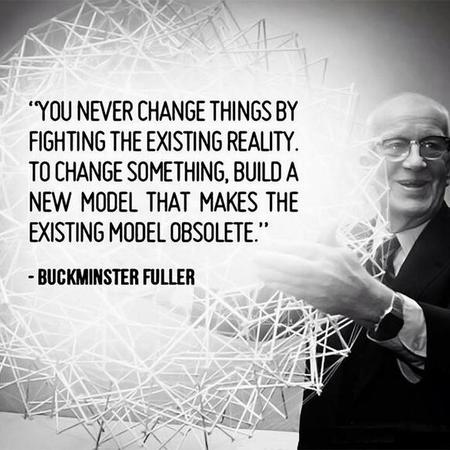
thermostat have been broken. Buckminster Fuller said that spaceship<br />
earth was so ingeniously designed that no one has a clue that we are on<br />
one, flying through the universe at a million miles per hour, with no<br />
need for seatbelts, lots of room in coach, and really good food &#8212; but<br />
all that is changing.</p>
<p>There is invisible writing on the back of the diploma you will receive,<br />
and in case you didn&#8217;t bring lemon juice to decode it, I can tell you<br />
what it says: You are Brilliant, and the Earth is Hiring. The earth<br />
couldn&#8217;t afford to send recruiters or limos to your school. It sent you<br />
rain, sunsets, ripe cherries, night blooming jasmine, and that<br />
unbelievably cute person you are dating. Take the hint. And here&#8217;s the<br />
deal: Forget that this task of planet-saving is not possible in the<br />
time required. Don&#8217;t be put off by people who know what is not<br />
possible. Do what needs to be done, and check to see if it was<br />
impossible only after you are done.</p>
<p>When asked if I am pessimistic or optimistic about the future, my<br />
answer is always the same: If you look at the science about what is<br />
happening on earth and aren&#8217;t pessimistic, you don&#8217;t understand the<br />
data. But if you meet the people who are working to restore this earth<br />
and the lives of the poor, and you aren&#8217;t optimistic, you haven&#8217;t got a<br />
pulse. What I see everywhere in the world are ordinary people willing<br />
to confront despair, power, and incalculable odds in order to restore<br />
some semblance of grace, justice, and beauty to this world. The poet<br />
Adrienne Rich wrote, &#8220;So much has been destroyed I have cast my lot<br />
with those who, age after age, perversely, with no extraordinary power,<br />
reconstitute the world.&#8221;</p>
<p>There could be no better description. Humanity is coalescing. It is<br />
reconstituting the world, and the action is taking place in<br />
schoolrooms, farms, jungles, villages, campuses, companies, refuge<br />
camps, deserts, fisheries, and slums.</p>
<p>You join a multitude of caring people. No one knows how many groups and<br />
organizations are working on the most salient issues of our day:<br />
climate change, poverty, deforestation, peace, water, hunger,<br />
conservation, human rights, and more.</p>
<p>This is the largest movement the world has ever seen. Rather than<br />
control, it seeks connection. Rather than dominance, it strives to<br />
disperse concentrations of power. Like Mercy Corps, it works behind the<br />
scenes and gets the job done.</p>
<p>Large as it is, no one knows the true size of this movement.</p>
<p>It provides hope, support, and meaning to billions of people in the<br />
world. Its clout resides in idea, not in force. It is made up of<br />
teachers, children, peasants, businesspeople, rappers, organic farmers,<br />
nuns, artists, government workers, fisherfolk, engineers, students,<br />
incorrigible writers, weeping Muslims, concerned mothers, poets,<br />
doctors without borders, grieving Christians, street musicians, the<br />
President of the United States of America, and as the writer David<br />
James Duncan would say, the Creator, the One who loves us all in such a<br />
huge way.</p>
<p>There is a rabbinical teaching that says if the world is ending and the<br />
Messiah arrives, first plant a tree, and then see if the story is true.<br />
Inspiration is not garnered from the litanies of what may befall us; it<br />
resides in humanity&#8217;s willingness to restore, redress, reform, rebuild,<br />
recover, reimagine, and reconsider. &#8220;One day you finally knew what you<br />
had to do, and began, though the voices around you kept shouting their<br />
bad advice,&#8221; is Mary Oliver&#8217;s description of moving away from the<br />
profane toward a deep sense of connectedness to the living world.</p>
<p>Millions of people are working on behalf of strangers, even if the<br />
evening news is usually about the death of strangers.</p>
<p>This kindness of strangers has religious, even mythic origins, and very<br />
specific eighteenth-century roots.</p>
<p>Abolitionists were the first people to create a national and global<br />
movement to defend the rights of those they did not know. Until that<br />
time, no group had filed a grievance except on behalf of itself. The<br />
founders of this movement were largely unknown &#8212; Granville Sharp,<br />
Thomas Clarkson, Josiah Wedgwood &#8212; and their goal was ridiculous on<br />
the face of it:</p>
<p>at that time three out of four people in the world were enslaved.<br />
Enslaving each other was what human beings had done for ages. And the<br />
abolitionist movement was greeted with incredulity. Conservative<br />
spokesmen ridiculed the abolitionists as liberals, progressives,<br />
do-gooders, meddlers, and activists. They were told they would ruin the<br />
economy and drive England into poverty. But for the first time in<br />
history a group of people organized themselves to help people they<br />
would never know, from whom they would never receive direct or indirect<br />
benefit. And today tens of millions of people do this every day. It is<br />
called the world of non-profits, civil society, schools, social<br />
entrepreneurship, non-governmental organizations, and companies who<br />
place social and environmental justice at the top of their strategic<br />
goals. The scope and scale of this effort is unparalleled in history.</p>
<p>The living world is not &#8220;out there&#8221; somewhere, but in your heart. What<br />
do we know about life? In the words of biologist Janine Benyus, life<br />
creates the conditions that are conducive to life. I can think of no<br />
better motto for a future economy.</p>
<p>We have tens of thousands of abandoned homes without people and tens of<br />
thousands of abandoned people without homes. We have failed bankers<br />
advising failed regulators on how to save failed assets. We are the<br />
only species on the planet without full employment. Brilliant. We have<br />
an economy that tells us that it is cheaper to destroy earth in real<br />
time rather than renew, restore, and sustain it. You can print money to<br />
bail out a bank but you can&#8217;t print life to bail out a planet. At<br />
present we are stealing the future, selling it in the present, and<br />
calling it gross domestic product. We can just as easily have an<br />
economy that is based on healing the future instead of stealing it. We<br />
can either create assets for the future or take the assets of the<br />
future. One is called restoration and the other exploitation. And<br />
whenever we exploit the earth we exploit people and cause untold<br />
suffering. Working for the earth is not a way to get rich, it is a way<br />
to be rich.</p>
<p>The first living cell came into being nearly 40 million centuries ago,<br />
and its direct descendants are in all of our bloodstreams. Literally<br />
you are breathing molecules this very second that were inhaled by<br />
Moses, Mother Teresa, and Bono. We are vastly interconnected. Our fates<br />
are inseparable. We are here because the dream of every cell is to<br />
become two cells. And dreams come true. In each of you are one<br />
quadrillion cells, 90 percent of which are not human cells. Your body<br />
is a community, and without those other microorganisms you would perish<br />
in hours. Each human cell has 400 billion molecules conducting millions<br />
of processes between trillions of atoms. The total cellular activity in<br />
one human body is staggering: one septillion actions at any one moment,<br />
a one with twenty-four zeros after it. In a millisecond, our body has<br />
undergone ten times more processes than there are stars in the<br />
universe, which is exactly what Charles Darwin foretold when he said<br />
science would discover that each living creature was a &#8220;little<br />
universe, formed of a host of self-propagating organisms, inconceivably<br />
minute and as numerous as the stars of heaven.&#8221;</p>
<p>So I have two questions for you all: First, can you feel your body?<br />
Stop for a moment. Feel your body. One septillion activities going on<br />
simultaneously, and your body does this so well you are free to ignore<br />
it, and wonder instead when this speech will end. You can feel it. It<br />
is called life.</p>
<p>This is who you are. Second question: who is in charge of your body?<br />
Who is managing those molecules? Hopefully not a political party. Life<br />
is creating the conditions that are conducive to life inside you, just<br />
as in all of nature. Our innate nature is to create the conditions that<br />
are conducive to life. What I want you to imagine is that collectively<br />
humanity is evincing a deep innate wisdom in coming together to heal<br />
the wounds and insults of the past.</p>
<p>Ralph Waldo Emerson once asked what we would do if the stars only came<br />
out once every thousand years. No one would sleep that night, of<br />
course. The world would create new religions overnight. We would be<br />
ecstatic, delirious, made rapturous by the glory of God. Instead, the<br />
stars come out every night and we watch television.</p>
<p>This extraordinary time when we are globally aware of each other and<br />
the multiple dangers that threaten civilization has never happened, not<br />
in a thousand years, not in ten thousand years. Each of us is as<br />
complex and beautiful as all the stars in the universe. We have done<br />
great things and we have gone way off course in terms of honoring<br />
creation.</p>
<p>You are graduating to the most amazing, stupefying challenge ever<br />
bequeathed to any generation. The generations before you failed. They<br />
didn&#8217;t stay up all night. They got distracted and lost sight of the<br />
fact that life is a miracle every moment of your existence. Nature<br />
beckons you to be on her side. You couldn&#8217;t ask for a better boss. The<br />
most unrealistic person in the world is the cynic, not the dreamer.<br />
Hope only makes sense when it doesn&#8217;t make sense to be hopeful. This is<br />
your century. Take it and run as if your life depends on it.</p>
<p>&#8230;&#8230;&#8230;.</p>
<p>Paul Hawken is a renowned entrepreneur, visionary environmental<br />
activist, and author of many books, most recently Blessed Unrest: How<br />
the Largest Movement in the World Came into Being and Why No One Saw It<br />
Coming. He was presented with an honorary doctorate of humane letters<br />
by University president Father Bill Beauchamp, C.S.C., in May, when he<br />
delivered this superb speech. Our thanks especially to Erica Linson for<br />
her help making that moment possible.</p>
<p><a href="http://www.paulhawken.com/multimedia/UofP_Commencement_05.03.09.pdf" target="_blank">http://www.paulhawken.com/multimedia/UofP_Commencement_05.03.09.pdf</a></div>
]]></content:encoded>
			<wfw:commentRss>http://greenstarstandard.com/news/?feed=rss2&amp;p=23</wfw:commentRss>
		<slash:comments>0</slash:comments>
		</item>
		<item>
		<title>Life Cycle Assessment 101: Why Does it Matter?</title>
		<link>http://greenstarstandard.com/news/?p=16</link>
		<comments>http://greenstarstandard.com/news/?p=16#comments</comments>
		<pubDate>Thu, 08 Oct 2009 00:09:19 +0000</pubDate>
		<dc:creator>Editor</dc:creator>
				<category><![CDATA[Life Cycle Assessment]]></category>

		<guid isPermaLink="false">http://greenstarstandard.com/news/?p=16</guid>
		<description><![CDATA[LCA IX is the annual meeting and conference of the American Center for Life Cycle Assessment (ACLCA). It brings together hundreds of academics and professionals in environmental life cycle, as well as industry, government, and NGOs. I was there this past week in Boston because I focus on sustainable engineering and design. One aspect of [...]]]></description>
			<content:encoded><![CDATA[<p>LCA IX is the annual meeting and conference of the <a href="http://lcacenter.org/" target="_blank">American Center for Life Cycle Assessment</a> (ACLCA). It brings together hundreds of academics and professionals in environmental life cycle, as well as industry, government, and NGOs. I was there this past week in Boston because I focus on sustainable engineering and design. One aspect of that is developing techniques to integrate Life Cycle Assessment (LCA) into the product development process. I am somewhat of an outsider in this club, but I do admit I left the conference with renewed vigor to find the intersection between LCA, sustainability and product development.</p>
<p>The goal of the conference was to discuss methods of life cycle assessment to promote sustainability in products, industries, infrastructure and companies. It was an interesting gathering of professionals from Europe, Asia and the Americas. On the whole, it was both an inspiring and daunting four-day experience. It is promising that the field is advancing quickly, but that hint of isolation lingered–as if you are among the few people on the planet that get the potential of this technology. It was like being at a meeting of a secret society. If you’re in, you know the lingo and you understand the importance, but if you’re not, it seems confusing and exclusive&#8230;</p>
<p><a title="Life Cycle Assessment 101: Why Does it Matter? " href="http://thenewgreeneconomy.com/blog/life-cycle-assessment-101-why-does-it-matter.html" target="_blank">http://thenewgreeneconomy.com/blog/life-cycle-assessment-101-why-does-it-matter.html</a></p>
]]></content:encoded>
			<wfw:commentRss>http://greenstarstandard.com/news/?feed=rss2&amp;p=16</wfw:commentRss>
		<slash:comments>0</slash:comments>
		</item>
		<item>
		<title>Green Star Standard News Established</title>
		<link>http://greenstarstandard.com/news/?p=1</link>
		<comments>http://greenstarstandard.com/news/?p=1#comments</comments>
		<pubDate>Fri, 28 Aug 2009 01:06:36 +0000</pubDate>
		<dc:creator>Editor</dc:creator>
				<category><![CDATA[Announcements]]></category>
		<category><![CDATA[Industry Standards]]></category>
		<category><![CDATA[Life Cycle Assessment]]></category>
		<category><![CDATA[News]]></category>
		<category><![CDATA[Sustainability]]></category>

		<guid isPermaLink="false">http://greenstarstandard.com/news/?p=1</guid>
		<description><![CDATA[Green Star Standard, greenstarstandard.com, www.greenstarstandard.com, sustainability, life cycle assessment, life cycle analysis, life cycle costing, life cycle cost analysis, LCCA, whole life cost, whole life accounting, zero waste, optimum resource utilization, pollution prevention, 
]]></description>
			<content:encoded><![CDATA[<p>Welcome to Green Star Standard!</p>
<p>News about sustainability and life cycle assessment (aka: life cycle analysis, life cycle costing, and many other names).</p>
<p>We will provide you with the best information about the &#8220;green&#8221; industry on a couple of fronts, including</p>
<ul>
<li>&#8220;green&#8221; industry standards (and our interpretation of what they mean)</li>
<li>news that relates to the &#8220;green&#8221; industry</li>
<li>ground-breaking green products and services for consumers and buyers at all levels</li>
<li>announcements about Green Star Standard</li>
</ul>
<p>We&#8217;re passionate about sustainability, zero waste, optimum resource utilization, pollution prevention, and more.</p>
<p>Welcome aboard!</p>
]]></content:encoded>
			<wfw:commentRss>http://greenstarstandard.com/news/?feed=rss2&amp;p=1</wfw:commentRss>
		<slash:comments>0</slash:comments>
		</item>
	</channel>
</rss>